Futures trading in Australia has moved well beyond its old image as a niche corner of the market reserved for institutions and macro specialists. In 2026, futures sit closer to the centre of the trading conversation because rates, volatility, energy shocks and portfolio hedging needs have all become more important. For Australian traders, that matters. Futures are not just speculative tools. They are practical instruments that allow traders, investors and businesses to express views, manage risk and stay flexible without constantly reshaping their entire portfolio.
At the same time, futures are unforgiving when used casually. Margin rules, liquidity conditions and contract structure can amplify mistakes just as quickly as they amplify good decisions. That is why the best way to approach futures in 2026 is not with excitement first. It is with clarity. A trader needs to know what the contract is for, what risk it carries, how much capital backs it and what role it plays on the ASX desk. Done properly, futures can make a portfolio more resilient and a trading book more efficient. Done poorly, they can turn ordinary volatility into forced decisions.
Why futures matter more in Australia in 2026
Futures matter in Australia because they sit at the point where macro policy, local market structure and real-world risk management meet. ASX says its ASX 24 market gives access to liquid interest-rate and equity derivative products including 3 and 10 Year Bond futures, 90 Day Bank Bill futures and SPI 200 Index futures, and it says average Q1 2026 volumes across key interest-rate futures were about 32 percent higher than the same period in 2025. That growth suggests futures are not fading into the background; they are becoming more relevant as traders and institutions respond to higher-for-longer rates and a more unstable global backdrop.
March 2026 also showed how quickly derivatives activity can accelerate when markets become more uncertain. ASX-linked reporting said the market was on track for its largest futures month on record in March 2026, with one day alone reaching 4.04 million contracts traded and a twelve-day streak of more than one million contracts a day. For Australian traders, the message is simple: futures are where serious risk transfer often happens first when markets become fast, nervous or heavily event-driven.
What a futures contract actually gives you
A futures contract gives you standardised exposure to an underlying benchmark or asset without requiring full upfront capital equivalent to the notional value of that exposure. Instead of paying the full value, you post margin and your position is marked to market as prices move. This creates capital efficiency, but it also creates daily accountability. Gains and losses are not abstract numbers on a watchlist. They affect available funds and risk capacity in real time.
On the ASX desk, that means futures can be used for several distinct purposes:
- Hedging an equity or bond portfolio.
- Taking a tactical macro view on rates or indices.
- Managing event risk around RBA decisions or major global releases.
- Adjusting exposure quickly without selling core long-term holdings.
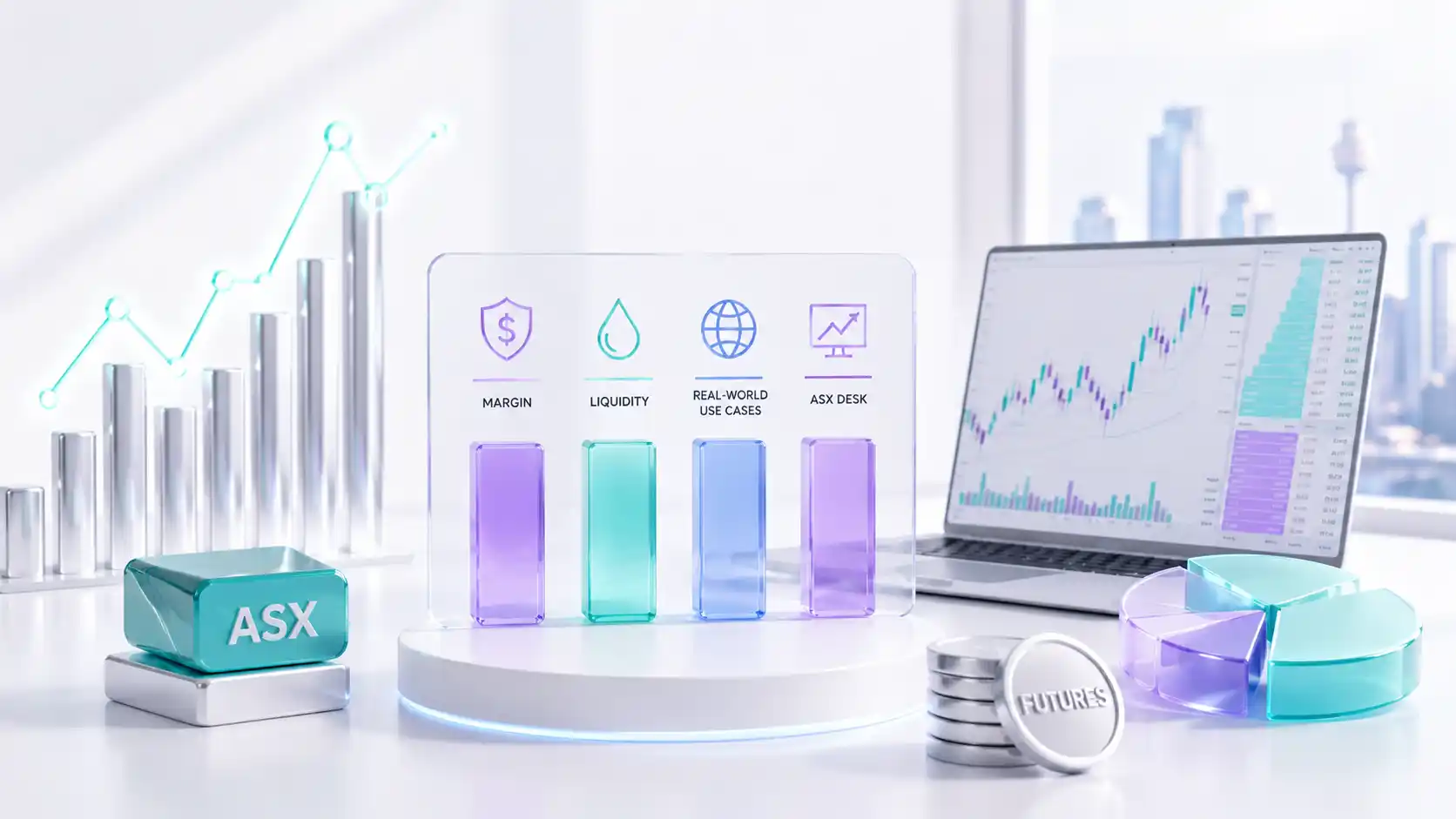
This flexibility is exactly why futures remain useful. But flexibility only helps when traders understand the cost of using it. Margin, liquidity and position sizing are what turn a futures idea into something sustainable.
Margin: the first concept every futures trader must respect
Margin is the core discipline of futures trading. ASX says ASX Clear (Futures) uses SPAN margin methodology and portfolio margining, with customers receiving capital efficiency within that clearing framework. In practice, this means a trader does not simply choose a contract and wait. They need enough capital to open the position, absorb variation in price and stay functional if markets move against them.
Many traders misunderstand margin because they treat it as buying power. That is the wrong mental model. Margin is not spare room for excitement. It is a buffer against adverse movement. If a trader uses most of their capital to support a leveraged position, they leave too little room for ordinary volatility. Then even a normal market move can trigger stress, forced reductions or poor decision-making.
Initial margin and variation margin
The two most useful concepts are initial margin and variation margin. Initial margin is the amount required to open the position. Variation margin reflects the day-to-day mark-to-market gains or losses as prices change. Together they define how much cash flow and flexibility a trader actually has.
| Margin Concept | What It Means | Why It Matters |
| Initial Margin | Capital posted to open a futures position | Determines whether you can enter and how much leverage you are using |
| Variation Margin | Daily profit and loss adjustment as markets move | Affects cash flow, staying power and emotional pressure |
| Excess Margin Buffer | Capital above the minimum margin requirement | Helps absorb volatility and reduces the risk of forced action |
Traders who understand these concepts treat futures differently. They stop asking, “How big can I trade?” and start asking, “How much movement can I fund without losing control?” That is the better question.
Why liquidity matters more than most traders think
Liquidity is often described as a technical market property, but for traders it is something more practical. It affects entry quality, slippage, spread costs and the ability to exit when conditions change. ASX says its futures market offers deep liquidity in key interest-rate and equity derivative products. That depth is a major reason futures remain useful for hedging and tactical trading, especially during periods when cash markets feel slower or less efficient.
Still, traders should not assume liquidity is identical across all times and all contracts. Even in active markets, conditions vary around roll periods, major announcements and overnight sessions. A contract can be broadly liquid and still trade awkwardly in certain windows. This matters especially for short-term traders who depend on quick execution and tight risk control.
How liquidity changes the quality of a setup
A high-conviction idea in a poor execution environment can become a weak trade. Liquidity affects:
- How close you get to the price you want.
- How much the market moves when you enter or exit.
- Whether stops behave in a predictable way.
- How much stress you face when volatility rises.
This is one reason ASX 24 products remain central for many Australian traders. The combination of standardisation, clearing and active participation creates a more usable environment than many fragmented or thin alternatives.
What contracts matter most on the ASX desk
For Australian traders, the most relevant contracts often sit in three broad groups:
- Interest-rate futures, including 90 Day Bank Bill and government bond futures.
- Equity index futures, especially SPI 200 contracts used to track or hedge broad market exposure.
- Selected energy or commodity-linked contracts when macro or sector exposure demands it.
ASX specifically highlights access to SPI 200 Index futures as well as major interest-rate contracts. That matters because these contracts link directly to the main drivers of Australian markets: the RBA, bond yields, equity sentiment and event risk.
Real-world use case one: hedging an Australian equity portfolio
One of the most practical uses of futures is hedging an equity portfolio without liquidating core long-term positions. A trader or investor with broad ASX exposure may want to reduce short-term downside risk around earnings seasons, RBA meetings or periods of geopolitical stress. Instead of selling a basket of shares and creating tax or timing complications, they can use SPI 200 futures to offset part of the market exposure.
This approach is especially useful for home-biased Australian portfolios. Many local portfolios already lean heavily toward banks, miners and domestic cyclicals. Those exposures can all come under pressure simultaneously when macro conditions deteriorate. Futures allow the trader to defend the portfolio while preserving long-term holdings.
How portfolio hedging typically works
A trader begins by estimating how much broad market beta the portfolio carries. They then decide how much of that beta should be temporarily reduced. The hedge is rarely perfect, because individual stock behaviour still matters, but it can materially reduce drawdowns during high-risk windows.
- Use futures when you want temporary protection without dismantling core holdings.
- Keep hedge size proportional to actual portfolio risk.
- Review the hedge after the event or risk window passes.
This is one of the clearest examples of futures functioning as tools, not toys.
Real-world use case two: trading the RBA and rates cycle
Australian futures are highly relevant when traders want to express views on rates. ASX says its interest-rate futures market has grown strongly, with Q1 2026 volumes in key contracts about 32 percent above the same period in 2025. That growth reflects how central the rates story has become in Australia, where inflation persistence, policy uncertainty and bond repricing affect almost every asset class.
A trader using interest-rate futures is not simply making a guess about one RBA meeting. They are expressing a view on the path of rates, policy expectations and the speed with which those expectations may change. This can be useful for:
- Macro traders positioning for a shift in policy tone.
- Investors seeking to offset duration exposure elsewhere.
- Portfolio managers needing flexible rate-sensitive hedges.
These trades demand discipline because markets often move before the RBA acts. Expectations, not just decisions, drive pricing.
Real-world use case three: tactical index trading
Not every futures use case is defensive. Some traders use SPI 200 futures to express directional views on the Australian market, especially around macro releases, offshore moves or earnings-heavy periods. The appeal is obvious: liquid exposure to the index, no need to build a basket of stocks and efficient response to changing conditions.
Tactical index trading can work well when the thesis is clear. Examples include:
- Expecting a relief rally after a less-hawkish-than-feared RBA tone.
- Positioning for downside after global risk deteriorates and energy shocks rise.
- Expressing a short-term view on broad ASX sentiment without choosing single stocks.
The key is to avoid mistaking easy access for easy profits. Index futures are efficient, but efficiency cuts both ways.
Real-world use case four: energy and market stress
In 2026, energy risk remains one of the most important cross-market forces. ASIC said market participants should be especially vigilant for suspicious activity and potential misconduct in energy futures and derivatives given the impact of conflict on energy markets. That warning highlights two realities at once: energy derivatives are highly relevant, and periods of stress can distort behaviour and increase operational risk.
For traders, this means energy-linked futures should be approached with extra care. They can be valuable for managing exposure or expressing views on supply shocks and geopolitical risk, but they require higher awareness of liquidity changes, headline risk and the possibility of sudden price gaps.
How Australian traders should think about broker access
Practical futures trading also depends on access. ASX’s futures broker list shows a limited set of brokers support retail clients directly, with Interactive Brokers Australia listed as supporting both ASX 24 and ASX Clear (Futures) participation for retail clients while many others are wholesale-focused. That matters because futures are not accessed in the same way as ordinary share trading; broker choice can shape available contracts, pricing, reporting and support.
Before trading, Australians should check:
- Which contracts their broker actually supports.
- Whether margining and reporting are transparent.
- How quickly the broker communicates during volatile periods.
- What risk controls and platform tools are available.
Good access does not replace good judgment, but poor access can make good judgment harder to implement.
Operational discipline: the hidden edge
ASIC’s 2026 guidance to market participants is a useful checklist for any serious trader. ASIC said participants should monitor positions for build-ups of risk or signs of distress, be well prepared for margin calls and maintain strong operational resilience and communication during stress. Although that language is aimed at the broader market ecosystem, the lessons apply directly to individual traders too.
Futures trading works better when operational habits are boring and consistent. That includes:
- Checking margin headroom daily.
- Knowing key event dates before they arrive.
- Avoiding oversized positions into volatile announcements.
- Reducing complexity when several correlated risks are active at once.
Traders often look for edge in forecasting, but many losses come from poor operations rather than poor ideas. Staying prepared is part of the strategy.
Common mistakes Australian futures traders make
Confusing leverage with opportunity
The first mistake is using leverage as if it were free upside. Futures allow capital efficiency, but that does not mean traders should maximise contract size. The more useful mindset is that leverage magnifies both skill and error. If the thesis is weak or the risk process is sloppy, leverage only accelerates the damage.
Ignoring liquidity conditions around events
Another mistake is trading as though liquidity is static. Event-driven markets can become messy even in otherwise active contracts. Traders who enter large positions into announcements without clear exit plans may discover that “liquid” does not always mean “comfortable.”
Using futures without a defined job
A futures position should always have a role. Is it a hedge, a tactical view, a duration adjustment or a volatility response? If the answer changes every few hours, the trade may be driven by emotion rather than structure. Clear purpose improves both execution and review.
A practical checklist before placing a futures trade
Before using any ASX futures contract, a trader should be able to answer the following:
- What exact exposure is this contract giving me?
- Is this trade a hedge, a tactical trade or a macro expression?
- How much capital is committed to initial margin and how much buffer remains?
- What happens if the market moves sharply against me today?
- Is liquidity likely to be normal during my planned entry and exit window?
- What event or condition would prove the trade wrong?
If any of these answers are vague, the position is probably not ready.
Why futures deserve respect on the ASX desk
Futures remain some of the most useful instruments in Australian markets because they combine speed, standardisation and flexibility. ASX data and market commentary show that 2026 has been a major year for futures activity, with strong participation in interest-rate products and record-level volume during volatile periods. That is exactly why futures deserve respect: they sit where serious money goes to manage serious risk.
For Australian traders, the right approach is balanced. Futures are neither magic nor inherently reckless. They are tools that work best when used with clear intent, conservative sizing and real operational discipline. If you understand margin, respect liquidity and give each position a clear job, futures can help the ASX desk become more adaptable and more precise. If you ignore those foundations, they become expensive very quickly.
FAQs: Futures trading for Australian traders in 2026
Are futures only for professional or institutional traders?
No, but they are more demanding than ordinary share trading. Some brokers provide retail access to ASX futures, yet the trader still needs to understand contract structure, margin and event risk before using them responsibly.
Why is margin so important in futures trading?
Margin determines how much capital supports your exposure and whether you can survive normal volatility without being forced into poor decisions. It is the operational backbone of any futures position.
What are the main futures use cases on the ASX desk?
The most common are hedging equity portfolios, expressing macro views on rates, trading broad index direction and managing event-driven risk around major announcements.
Does high liquidity mean a futures trade is automatically safe?
No. Good liquidity improves execution, but it does not remove thesis risk, leverage risk or event-driven volatility. A liquid contract can still produce painful outcomes if position sizing is poor.
Why are energy futures getting extra attention in 2026?
ASIC has specifically called for vigilance in energy futures and derivatives because conflict-driven energy volatility can increase the risk of suspicious activity and operational stress in those markets.
What is the biggest mistake beginners make with futures?
The biggest mistake is usually trading too large because the initial margin requirement looks smaller than the notional exposure. That creates fragile positions that cannot absorb normal market movement.