Canadian investors in 2026 are dealing with a market that looks strong on the surface but requires more selectivity than the headline index suggests. The TSX still benefits from its structural weight in energy, financials and materials, which gives it a different personality from the S&P 500 and other growth-heavy benchmarks. That difference can be an advantage in a world where inflation shocks, geopolitical disruptions and industrial cycles matter again. But it also creates concentration risk. If a Canadian portfolio leans too heavily on TSX energy, domestic banks and a handful of global tech names, it can become more fragile than it appears.
This is the central challenge for Canadian stocks trading in 2026. Investors want the cash-flow strength and dividend support of traditional TSX leaders. They also want exposure to global tech, AI infrastructure and other growth themes that are shaping capital markets worldwide. The answer is not to choose one side and ignore the other. It is to balance them without accidentally creating a portfolio that depends on one policy outcome, one commodity move or one narrative staying alive forever.
This article explains how Canadian investors can build that balance. It looks at why the Bank of Canada matters, how TSX sector structure shapes opportunity, why energy and banks still deserve attention and how global tech can be added without overwhelming the risk profile. The focus is practical, portfolio-aware and built for 2026 realities rather than old diversification clichés.
Why the TSX still looks different in 2026
The TSX is not a generic developed-market index. It remains much more exposed to energy, financials, materials and industrial cyclicals than US benchmarks. Reuters reported in February 2026 that Canada’s main stock index was expected to reach additional record highs, helped by elevated commodity prices and investor rotation toward established industries that could benefit from a stronger industrial cycle. Reuters also noted that technology represented only 8.8 percent of TSX market capitalisation, while financial, industrial and commodity-related sectors carried much more weight.
That matters because sector composition drives portfolio behaviour. A Canadian investor who says they are “diversified” simply because they own the TSX is often more concentrated in energy, banks and materials than they realise. That concentration can be helpful when commodities are strong and dividends are valued, but it can also lead to disappointment if one or two sectors carry the entire portfolio narrative. Balancing TSX strength with wider growth exposure is therefore less about style preference and more about structural risk management.
| TSX Characteristic | Why It Matters | Portfolio Implication |
| High energy weight | Benefits from oil and gas strength, geopolitical risk and inflation hedging | Can boost returns, but increases commodity sensitivity |
| Large bank exposure | Supports dividends, income and domestic financial stability themes | Creates rate, housing and credit-cycle dependency |
| Smaller tech share | Reduces dependence on mega-cap tech | May leave growth-heavy investors underexposed to global innovation |
| Strong materials presence | Links index to gold, metals and industrial cycles | Adds inflation and global growth sensitivity |
Once investors understand these structural features, portfolio decisions become more deliberate. They stop treating TSX exposure as neutral and start seeing it for what it is: a value- and commodity-tilted market with important strengths and clear blind spots.
Bank of Canada policy and why it still matters for stocks
Canadian stocks in 2026 still trade under the shadow of interest rates, inflation and policy uncertainty. The Bank of Canada said in April 2026 that growth was expected to improve gradually while inflation would rise in 2026 because of higher gasoline prices linked to the war in the Middle East before easing later. Reuters also reported that the Bank of Canada slightly raised its growth forecasts for 2026 and 2027, while expecting inflation in 2026 to average 2.3 percent before easing. For investors, that means policy is no longer in emergency mode, but it is still central to valuation, sector rotation and economic sensitivity.
This matters most because different TSX sectors respond differently to the same policy backdrop. Banks care about loan growth, credit quality and curve dynamics. Energy reacts more to oil prices and geopolitics, but inflation and growth still matter. Global tech exposure is highly sensitive to discount rates and broad risk appetite. A balanced Canadian portfolio therefore has to absorb several policy channels at once rather than assuming one macro narrative fits every holding.
Energy on the TSX: strength, inflation hedge and concentration risk
Energy remains one of the defining features of Canadian equities. Reuters-linked reporting cited by Nicola Wealth said energy made up about 19 percent of the TSX and had risen more than 40 percent since the start of the year in 2026, driven in part by the Iran-linked oil price surge. Reuters also reported in March 2026 that Canada was relatively insulated from the latest energy shock because it is a net oil exporter, while energy stocks had climbed and reached their highest level since 2008 during that stretch. For Canadian investors, this gives energy an unusual dual role: it is both a return driver and a potential macro hedge when inflation is pushed higher by oil.
That said, energy strength can become a trap if investors mistake tailwinds for permanence. Oil prices are cyclical, geopolitical premiums can fade quickly and even high-quality energy names can correct sharply when the market decides recession risk matters more than supply tightness. This is why smart Canadian stocks trading uses energy as a strong pillar, not as an excuse to ignore balance.
What energy does well in a Canadian portfolio
- Provides cash-flow exposure during periods of firm commodity pricing.
- Acts as a partial hedge when inflation is driven by fuel and transport costs.
- Offers dividend support and capital-return potential in disciplined businesses.
- Links portfolios to global supply dynamics rather than just domestic demand.
Where investors go wrong with energy
- They let one strong sector become too large after a rally.
- They assume every energy company has the same quality and balance-sheet strength.
- They ignore how energy concentration interacts with materials and banks in a cyclical downturn.
- They treat high dividends as protection against all forms of downside.
In practice, energy deserves respect and position limits at the same time. A smart portfolio uses energy as a stabilising return engine and inflation-sensitive hedge, but not as the whole story.
Canadian banks: still core, but no longer automatic
Canadian banks remain central to domestic equity portfolios because they combine scale, dividends, brand familiarity and a history of resilience. But 2026 is a year when investors need to be more selective. BNN Bloomberg reported in July 2026 that Canadian banks faced a valuation test while energy risks remained one of the biggest market concerns. Nicola Wealth’s market commentary also noted that several major banks beat quarterly profit estimates, but some of those strong results appeared to have already been priced in.
This is an important shift. The old default trade of simply owning banks and collecting yield is not automatically wrong, but it is less effortless than investors sometimes assume. Funding conditions, domestic growth, consumer resilience, commercial activity and housing sensitivity all matter. Canadian banks still deserve a core role, but their role needs to be defined in the context of valuation and total portfolio concentration.
Why banks still matter
- They provide income through dividends and large-cap stability.
- They are deeply linked to the domestic economy and credit conditions.
- They can benefit from stable or improving growth without relying on speculative narratives.
- They offer institutional-quality exposure within a home market many investors understand well.
Why banks should not dominate the whole portfolio
Banks bring their own concentration risks. A portfolio overloaded with financials and energy can look diversified by name count while still depending on a narrow set of outcomes: stable credit, manageable inflation, decent growth and no severe shock to commodity or housing-linked sentiment. That is why banks should usually remain a core sleeve, not become the whole portfolio identity.
Global tech: necessary, but best used selectively
One of the defining investor dilemmas in Canada is how much global tech exposure to carry. The TSX does not offer the same concentration of mega-cap tech found in the US, yet global growth and AI themes are too important to ignore. Bank of Canada Governor Tiff Macklem said in early 2026 that structural change in Canada was being shaped partly by AI, alongside US protectionism and slower population growth. That means even domestic investors cannot treat technology as a foreign side topic. It is part of the macro and capital-allocation environment now.
At the same time, global tech should not be added carelessly as a FOMO sleeve. If Canadian investors already hold TSX energy, banks and materials, adding concentrated US or global tech positions without size discipline can create a portfolio that swings violently between value and duration-sensitive growth. The better approach is selective, deliberate and tied to clear purpose.
How to add global tech without overloading risk
- Use tech as a growth complement, not as a replacement for the portfolio core.
- Focus on quality businesses with durable cash flows or clear AI infrastructure relevance.
- Avoid duplicating the same growth factor across too many names or funds.
- Scale positions based on valuation sensitivity and overall portfolio balance.
This approach lets Canadian investors participate in innovation without surrendering the stabilising features that make the TSX distinct in the first place.
The real challenge: balancing three engines that behave differently
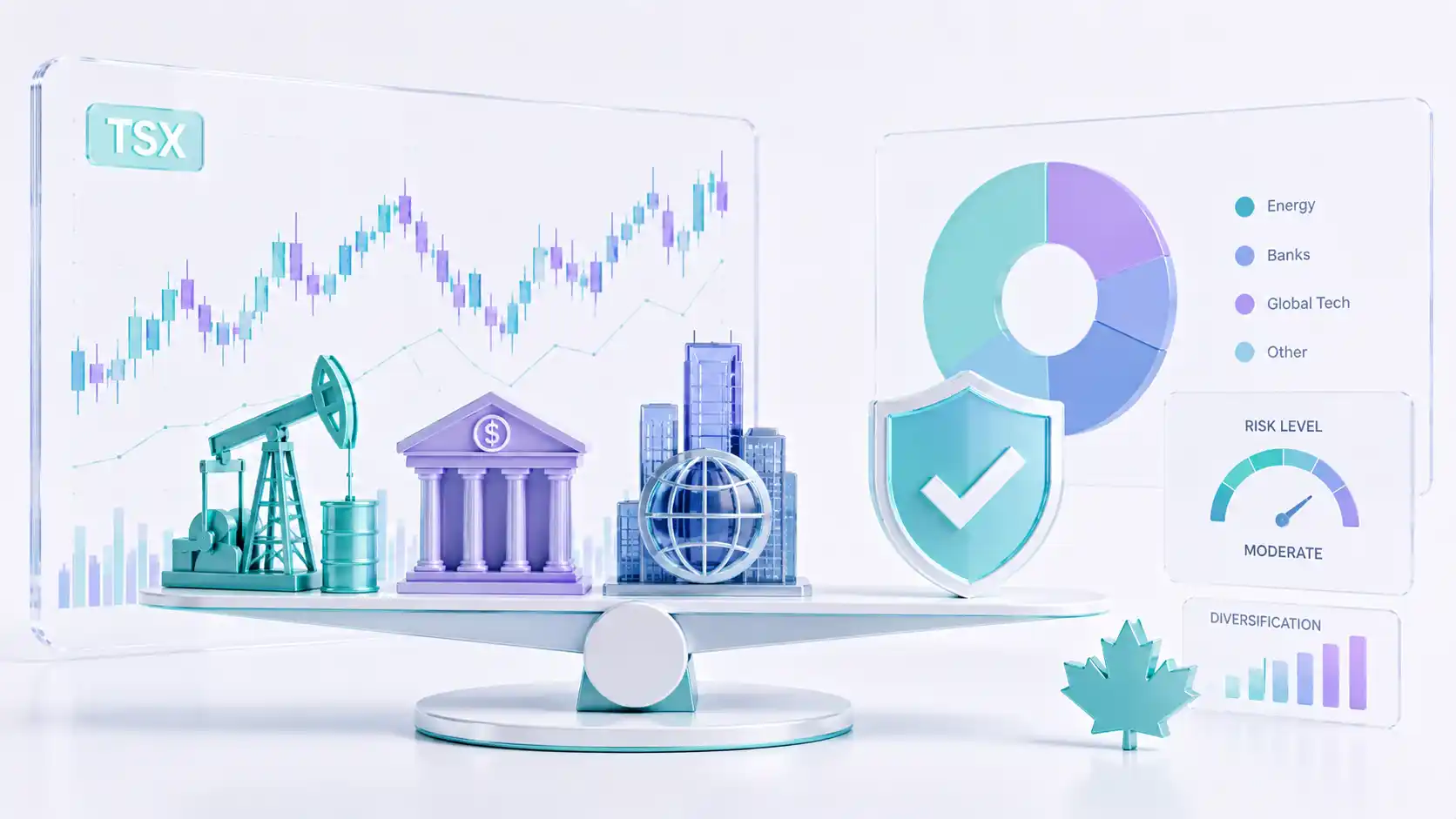
The smartest Canadian portfolios in 2026 usually balance three broad engines:
- TSX energy for inflation sensitivity, commodity strength and cash-flow support.
- Canadian banks for dividends, domestic economic exposure and large-cap resilience.
- Global tech for growth, AI exposure and long-term structural upside.
The challenge is that these engines do not respond well to the same environment. Energy can outperform when inflation or geopolitics drive oil higher. Banks may do best in a stable growth environment with manageable rates and credit conditions. Global tech often thrives when liquidity improves and investors feel comfortable paying for long-duration earnings. A portfolio built without understanding these differences can become internally inconsistent.
| Portfolio Engine | Best Environment | Main Risk | How to Keep It Balanced |
| TSX Energy | Firm oil prices, geopolitical stress, inflation-sensitive markets | Commodity reversals, recession fears | Use as a strong sleeve, but cap concentration |
| Canadian Banks | Stable growth, healthy credit, controlled inflation | Housing and loan stress, valuation compression | Stay diversified across financials and watch valuations |
| Global Tech | Improving liquidity, AI enthusiasm, lower duration pressure | Multiple compression, sentiment reversals | Use selective exposure and avoid growth stacking |
Thinking in engines rather than isolated names helps investors understand why balancing matters more than chasing whichever segment performed best last month.
A practical portfolio framework for Canadian investors
A useful way to structure a Canadian equity book is to separate it into core, growth and tactical sleeves.
1. Core sleeve
This is the stability engine of the portfolio. It typically includes:
- Large Canadian banks.
- Selected energy majors or infrastructure-linked names.
- High-quality materials or dividend-paying industrials.
The core sleeve is built to carry the portfolio through ordinary market conditions. It should not depend on heroic assumptions.
2. Growth sleeve
The growth sleeve adds structural upside and innovation exposure. It may include:
- Global tech leaders.
- AI infrastructure and software exposure.
- Selective Canadian tech or digital-platform names where valuation is acceptable.
The growth sleeve should be large enough to matter but small enough that a tech selloff does not redefine the entire portfolio.
3. Tactical sleeve
This sleeve expresses shorter-term views on macro and sector rotation. It can be used for:
- Temporary overweights in energy when geopolitical risk rises.
- Adjustments to bank exposure when policy expectations shift materially.
- Opportunistic additions to tech during valuation resets or improving liquidity conditions.
Separating tactical from core positions reduces emotional confusion. A short-term trade no longer has to masquerade as a long-term investment when it moves against expectations.
Sector rotation in Canada in 2026
Sector rotation matters more in Canada than in many markets because index returns are often driven by only a few heavyweight groups. Reuters reported that strategists expected TSX gains in 2026 to be supported by elevated commodity prices and a shift toward established industries that benefit from an improving industrial cycle. Marketscreener also reported in March 2026 that technology and miners helped lead gains on the TSX while investors watched major central-bank meetings and Middle East tensions.
The implication is clear: Canadian equity performance is not a one-theme story. Energy, materials, banks and tech can each lead at different times. Investors who understand rotation can use it to rebalance rather than react emotionally. Investors who ignore rotation often end up buying what already ran and selling what may be about to recover.
Useful rotation questions to ask
- Is the market rewarding inflation hedges or duration-sensitive growth?
- Are commodity prices supporting TSX leadership or starting to fade?
- Are bank valuations still reasonable relative to earnings expectations?
- Is global tech being added for growth balance or simply because of recent performance?
These questions are simple, but they help stop portfolios from drifting into accidental concentration.
Common mistakes Canadian investors make in 2026
Letting the TSX do all the diversification work
Many investors assume that owning a broad TSX fund means the portfolio is automatically balanced. In reality, the TSX carries large energy, financial and materials weights, so it needs complementary growth and global exposure to become more rounded.
Overweighting whatever just worked
If energy has rallied sharply, investors often increase exposure right when concentration risk is rising. The same thing happens with global tech after strong AI-led runs. Smart investing means rebalancing into strength rather than turning winners into oversized bets.
Ignoring how sectors interact
A portfolio can look diversified by sector labels while still depending on the same macro outcome. Energy, materials and banks may all suffer together in a sharp growth shock. Tech and long-duration growth can all feel the same pressure in a rate-driven selloff. Looking at macro sensitivity matters more than counting line items.
FAQs: Canadian stocks trading in 2026
Why are energy and banks still so important in Canada?
Because the TSX remains heavily weighted toward those sectors, and both continue to drive index behaviour through dividends, cash flow and sensitivity to macro conditions.
Should Canadian investors reduce TSX exposure and move entirely into US tech?
Usually no. The better solution is balance. The TSX offers energy, materials and financial exposure that can diversify a tech-heavy world, while selective global tech adds growth the TSX lacks.
How does Bank of Canada policy affect Canadian stocks?
It affects inflation expectations, credit conditions, valuation multiples and sector leadership, especially in banks and growth-sensitive assets.
What is the biggest risk in a Canadian equity portfolio in 2026?
The biggest risk is often concentration hidden inside a “broad” TSX allocation, especially when energy and financials both dominate the portfolio and global growth exposure is added without size discipline.
How can investors add tech without overloading risk?
Use a defined growth sleeve, focus on quality and avoid stacking too many similar growth exposures. Tech should complement the Canadian core, not overwhelm it.
Is sector rotation still worth following for long-term investors?
Yes, because sector rotation helps investors rebalance intelligently and understand when the market is rewarding value, commodities, defensives or growth. That improves portfolio discipline even for long-term holders.